
How to Choose an Auger Conveyor for Fertilizer in 2026?

Time:2026-09-30 Author:Aria
0%

Choosing an Auger Conveyor For Fertilizer in 2026 requires more than matching capacity to motor power. Fertilizer handling conditions vary sharply between dry urea, granular blends, phosphate products, and damp materials. A conveyor that performs smoothly in a warehouse may struggle near a blending line. Moisture can create buildup around the flighting. Fine dust can enter seals and shorten bearing life. Incline angle also changes capacity, energy use, and discharge consistency.

This guide focuses on practical selection decisions that affect daily operation. It examines screw diameter, flight design, trough or tube construction, drive configuration, speed control, and cleanout access. Operators should compare the required tons per hour with real bulk density, not only catalog figures. A small test with the actual fertilizer can reveal flow problems before installation. That matters.

In field assessments, maintenance access often proves as important as theoretical efficiency. A removable cover, visible inspection point, and replaceable wear section can reduce downtime during peak application seasons. Corrosion-resistant materials may cost more initially, but fertilizer dust and humidity can make cheap steel expensive later. Electrical protection and guarding should follow applicable local requirements and professional engineering practices.

No selection method is perfect. A spreadsheet may miss sticky buildup or awkward discharge positioning. Even experienced teams can underestimate cleaning time. The best choice balances throughput, product protection, reliability, sanitation, and future expansion. By reviewing these factors carefully, buyers can choose equipment that works beyond the first successful test.
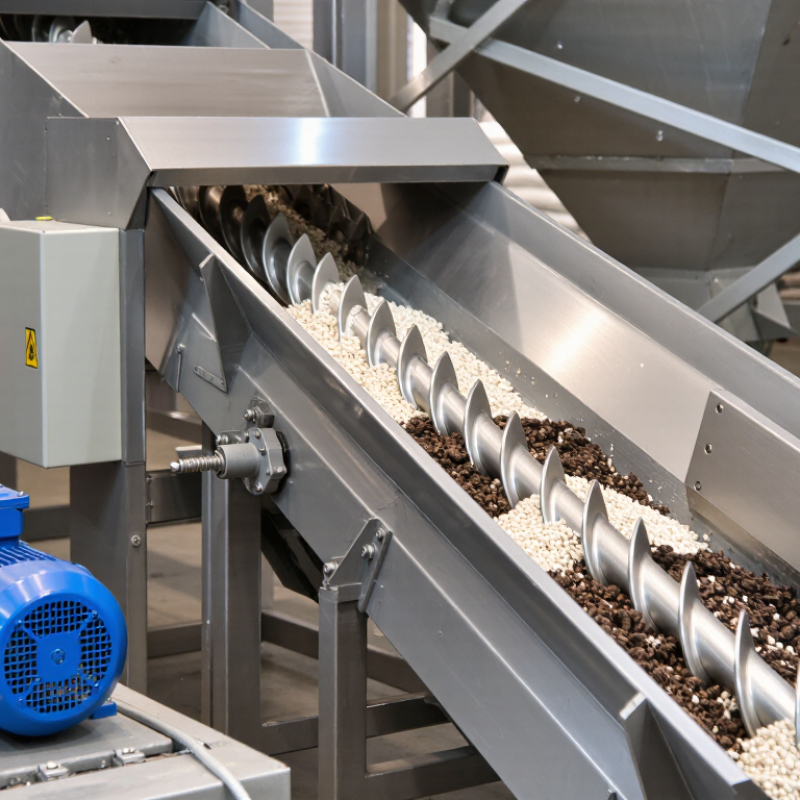
How to Choose an Auger Conveyor for Fertilizer in 2026?

Classify Fertilizer and Measure Loose Bulk Density Using ISO 3944

How to Choose an Auger Conveyor for Fertilizer in 2026?

Fertilizer selection should begin with classification, not conveyor speed. Identify whether the material is granular, prilled, crystalline, or powdered. Particle shape, moisture, flowability, and abrasiveness affect auger performance. A product may look uniform in the bag, yet separate during storage. That hidden change can alter feeding accuracy. For this reason, collect samples from different points, then examine them under consistent conditions.

Loose bulk density is essential for sizing an auger conveyor. Follow ISO 3944 when measuring it, using a representative fertilizer sample and a calibrated container with known volume. Fill the container without compacting the material, level the surface, and record the mass. Divide mass by container volume to obtain loose bulk density. Repeat the test and compare the results. A single measurement can mislead you. Moisture, vibration, and operator technique may influence the value. I would not trust a conveyor calculation based on a supplier’s density alone.

Tips: Record density in kilograms per cubic metre, along with moisture and temperature. Use the highest realistic density for motor-load checks, but verify the lowest density for capacity calculations. Select an auger diameter and pitch that protect fragile granules. Keep the inlet flooded evenly, and avoid excessive speed that creates dust or particle breakage. One practical mistake is ignoring startup torque. A conveyor that works empty may struggle when fertilizer settles overnight. Recheck the design after field testing, because laboratory conditions are never perfect.

Check Design Inputs Against Typical Urea (720–800) and DAP (900–1,100 kg/m³)

How to Choose an Auger Conveyor for Fertilizer in 2026?

Bulk density should shape the auger design, not appear as an afterthought. Urea commonly falls between 720 and 800 kg/m³, while DAP often ranges from 900 to 1,100 kg/m³. These figures align with ranges referenced in the IFDC Fertilizer Manual, 3rd edition. At the same volume rate, DAP can place substantially more load on the conveyor drive. Calculate mass flow as volume flow multiplied by bulk density. Then check screw diameter, rotational speed, trough loading, and motor torque against that result. CEMA’s Screw Conveyors for Bulk Materials, 5th edition, also stresses capacity checks under actual loading conditions. A neat spreadsheet is not enough.

Moisture, granule size, and incline can change performance quickly. A horizontal auger may handle the target rate, yet a rising conveyor can lose capacity. Urea can compact around transfer points. DAP granules may fracture when speed or drop height is excessive. Select materials and clearances for fertilizer contact, then verify corrosion resistance with the supplier’s technical data. I would not design only for the average density. That shortcut often creates an undersized drive during DAP campaigns.

Tips: Request a representative material sample. Measure loose and settled density separately. Test the auger at the planned fill level and incline. Leave practical margin, but do not oversize blindly; excessive speed can increase dust, segregation, and wear. Recheck assumptions after seasonal product changes.

How to Choose an Auger Conveyor for Fertilizer in 2026?

Check design inputs against typical urea and DAP bulk density values

Typical bulk density is approximately 720–800 kg/m³ for urea and 900–1,100 kg/m³ for DAP. The chart uses the midpoint of each range as a planning reference. Higher-density DAP produces a greater mass flow at the same volumetric auger capacity, so conveyor sizing should also verify required throughput, screw diameter, speed, inclination, moisture, particle size, and the actual material test data.

Convert Required Throughput in t/h into Screw Diameter, Pitch, and Speed

Choosing an auger conveyor for fertilizer starts with required throughput, not guesswork. Convert the target mass flow into volumetric flow before selecting equipment. Use this equation: Q = throughput ÷ bulk density. A 25 t/h requirement with 0.9 t/m³ fertilizer equals about 27.8 m³/h.

Then estimate screw capacity using the screw diameter, shaft diameter, pitch, rotational speed, and filling factor. A practical equation is Q = 60 × π/4 × (D² − d²) × P × N × F. Here, D and d are diameters, P is pitch, N is rpm, and F represents filling. For example, a 350 mm screw with a 100 mm shaft, 280 mm pitch, 55 rpm, and 35% filling may approach 28 m³/h.

But the estimate is incomplete. Inclined conveyors lose capacity, while damp fertilizer may bridge, smear, or cling to flights. Keep the filling factor conservative, especially with irregular granules. A larger pitch can increase output, but it may reduce conveying control and raise segregation risk. Higher speed also increases wear and product degradation.

Check the result against motor torque and startup load. The screw should not operate continuously at its limit. Field measurements often differ from laboratory data. That difference matters. Leave operating margin, then confirm performance with the actual fertilizer, moisture level, conveyor angle, and feeding method. Calculation guides selection; testing proves it.

Apply CEMA 350 Capacity and Power Methods to Select Conveyor Geometry

How to Choose an Auger Conveyor for Fertilizer in 2026?

Apply CEMA 350 Capacity and Power Methods to Select Conveyor Geometry

Fertilizer demand is rising, but material behavior remains unpredictable. The International Fertilizer Association’s Medium-Term Fertilizer Outlook 2024–2028 projects global nutrient demand near 194 million tonnes in 2024/25. That volume increases pressure on transfer equipment, especially during seasonal peaks. CEMA 350 provides a practical method for sizing an auger conveyor. Start with required capacity, bulk density, screw diameter, pitch, rotational speed, and loading percentage. A larger diameter is not always better. Excessive speed can increase degradation, dust, and segregation.

A larger diameter is not always better. Excessive speed can increase degradation, dust, and segregation.

Use the CEMA capacity calculation to compare geometry options under real operating conditions. Then estimate power from conveyor friction, material resistance, and vertical lift. Inclined conveyors need additional power. Fertilizer products can vary widely in density and flowability, so use measured values rather than catalogue assumptions. The first estimate is rarely perfect. Field testing may expose buildup near the inlet or unexpected torque during startup. Include a sensible service factor, but do not hide poor geometry behind an oversized motor. CEMA guidance should be checked against actual operating data and the equipment supplier’s test results.

Tips:

Record bulk density from several production batches. Check moisture, particle size, and angle of repose. Keep screw loading conservative when material is abrasive or easily compacted. Confirm shaft torque, hanger spacing, inlet design, and emergency stopping performance. I would also review one abnormal condition, such as a partly blocked discharge. That scenario often changes the final selection.

References: CEMA 350, Screw Conveyors for Bulk Materials; International Fertilizer Association, Medium-Term Fertilizer Outlook 2024–2028.

Verify Corrosion, Abrasion, Incline, and Discharge Needs with Material Tests

How to Choose an Auger Conveyor for Fertilizer in 2026?

Fertilizer can look dry and harmless, yet it may attack steel within weeks. Before choosing an auger conveyor, test the actual product, not a catalog sample. Use the real material. Collect fresh fertilizer from production and measure moisture, particle size, temperature, and bulk density. These details change torque, flow, and service life. A laboratory sample may behave differently from fertilizer exposed to storage humidity.

For corrosion testing, expose metal coupons to the fertilizer under realistic moisture and temperature conditions. Check for pitting, discoloration, and coating damage. Include fertilizer dust around seals and bearings. Visual inspection alone is unreliable. For abrasion, run a timed sample through the proposed screw material. Measure mass loss and inspect flight edges under magnification. A short test can mislead, especially with coarse granules.

Test the auger at its planned incline and operating speed. Record current draw, throughput, vibration, and product buildup. Steeper angles may reduce capacity more than expected. Discharge testing also matters. Observe bridging, residue, and uneven flow at the outlet. If the conveyor feeds a bagging or blending system, repeat tests during stop-start cycles. One overlooked detail can create daily blockages. I would also retest after several hours, because early results often look too optimistic. Keep every test condition documented, including cleaning intervals and rejected samples.

How to Choose an Auger Conveyor for Fertilizer in 2026? - Verify Corrosion, Abrasion, Incline, and Discharge Needs with Material Tests
Evaluation Area Typical Fertilizer Conditions Material Test or Measurement Selection Guidance for the Auger Conveyor Verification Target Before Purchase
Fertilizer Type Common granular products include urea, ammonium sulfate, DAP/MAP phosphate fertilizer, and potassium chloride. Their particle size, moisture, hardness, and chemical composition can vary by supplier and production batch. Test the actual product for particle-size distribution, bulk density, moisture content, angle of repose, and flowability. Use representative samples from the intended production stream. Select the screw diameter, pitch, speed, inlet geometry, and drive torque from measured product properties rather than from fertilizer name alone. Require a product-specific test report using the same fertilizer grade and moisture range expected during operation.
Bulk Density Granular fertilizer bulk density commonly falls within approximately 600–1,200 kg/m³, depending on product, granule size, void space, and moisture. Measure loose and tapped bulk density using a calibrated container and a repeatable filling procedure. ASTM D1895 methods can be used as a reference for bulk-density testing. Use the measured bulk density to calculate mass flow, motor load, hopper pressure, and required conveyor capacity. Do not size the conveyor from volume capacity alone. Capacity calculations should use both the lowest and highest expected bulk-density values.
Corrosion Risk Ammonium sulfate and phosphate fertilizers may create acidic or corrosive residues. Potassium chloride introduces chloride ions that can increase corrosion risk, especially with moisture. Dry urea is generally less aggressive than wet fertilizer residues. Perform immersion or wet-residue corrosion testing with the actual fertilizer solution or slurry. ASTM G31 may be used as a reference for laboratory immersion testing. Consider corrosion-resistant wetted parts, sealed bearings, effective drainage, and designs that prevent fertilizer accumulation in crevices. Material choice should be based on the test results and cleaning conditions. Compare candidate construction materials after exposure to the expected concentration, temperature, and exposure time. Inspect for pitting, surface attack, cracking, and fastener corrosion.
Abrasion and Granule Impact Dry granular fertilizer can cause moderate abrasion, while contaminated product containing sand, clay, or recycled fines can be significantly more abrasive. High screw speed increases sliding and impact wear. Run a comparative wear test using the actual product and any known contaminants. ASTM G65 can be used as a general reference for dry abrasive wear comparison, although fertilizer-specific testing is preferred. For abrasive service, consider thicker flight edges, replaceable wear liners, reduced operating speed, and easy access for inspection. Avoid unnecessary drop height at transfer points. Establish a maximum acceptable wear rate or dimensional loss during a defined test period before finalizing flight and trough materials.
Moisture and Caking Moisture can cause fertilizer granules to cake, bridge, smear, or partially dissolve. Hygroscopic products are particularly sensitive to humid storage and condensation. Measure moisture content and perform a controlled flow test after exposure to the expected humidity or water addition. Record changes in flowability and lump formation. Use covered inlets, sealed housings, drainage provisions, cleanout access, and sufficient starting torque. Avoid dead zones where wet fertilizer can harden. The conveyor should start and discharge after the longest expected idle period without manual removal of compacted fertilizer.
Particle Size and Breakage Commercial fertilizer granules are often supplied in a broad size distribution. Oversize particles and fines can increase torque, segregation, dust, and product degradation. Record the particle-size distribution by sieve analysis and measure the percentage of fines and oversize particles. Compare feed and discharged samples for degradation. Use a suitable flight pitch and moderate rotational speed. Minimize abrupt transitions, excessive compression, and long unsupported drops into the screw. Define an allowable increase in fines and confirm that the discharged product remains within the required particle-size specification.
Incline Angle Horizontal conveying provides the highest practical capacity. Inclined operation generally reduces capacity and increases power demand because some material slips backward along the flight. Test the actual product at the planned angle, such as 10°, 15°, 20°, or 30°, while recording capacity, motor current, discharge consistency, and backflow. Expect a capacity reduction as incline increases. Use a larger conveyor, lower speed, closer pitch, or a secondary conveying method when the required rate cannot be maintained. Confirm the required mass flow at the exact installation angle, not only during a horizontal factory test.
Conveyor Capacity Required capacity should be stated as mass flow, such as tonnes per hour, together with bulk density, fill level, screw speed, and operating schedule. Conduct a timed test at minimum, normal, and maximum feed rates. Weigh the discharged fertilizer and record motor current and rotational speed. Select the conveyor using the worst credible combination of low bulk density, high moisture, maximum incline, and required throughput. Confirm stable output at the target rate with adequate reserve capacity and without sustained motor overload.
Discharge Arrangement Fertilizer may need to discharge into a bin, blender, bagging machine, spreader, bucket elevator, or a second conveyor. Each application has different requirements for flow control and segregation. Test discharge at the planned outlet size and position. Check for bridging, residual material, surging, segregation, dust release, and uncontrolled dribble after shutdown. Choose bottom, end, or multiple discharge points according to the process layout. Use controlled gates or variable-speed operation where accurate dosing is required. Verify that the outlet clears adequately and that the discharged product meets the downstream equipment's feed requirements.
Feeding and Hopper Interface Poorly designed hoppers can cause funnel flow, bridging, uneven loading, or sudden surges. These issues may be mistaken for conveyor undercapacity. Conduct a flow test with the actual hopper geometry and fertilizer. Observe the fill pattern, drawdown, bridging tendency, and inlet loading across the full operating range. Use a properly sized inlet, mass-flow hopper geometry where appropriate, agitators only when necessary, and guards against large lumps entering the screw. The screw should receive a consistent feed without excessive flooding, intermittent starvation, or localized overload.
Drive Torque and Starting Starting torque can be substantially higher after a wet or caked fertilizer has remained in the trough. Inclines and full-start conditions further increase the load. Measure running current and starting behavior under empty, normal-load, and worst-case loaded conditions. Include a restart test after a controlled idle period. Size the motor, gearbox, shaft, and coupling for peak starting torque, not only average running power. Consider soft starting or variable-frequency control where suitable. The conveyor should restart without nuisance trips, excessive shaft deflection, abnormal noise, or coupling slip.
Dust and Sealing Fertilizer fines can become airborne during loading, transfer, and discharge. Dust may enter bearings and gearboxes or accumulate on surrounding equipment. Observe dust generation during maximum-rate operation and inspect bearing areas, covers, inspection doors, and discharge transitions for leakage. Use covered troughs, suitable seals, external bearings where practical, controlled transfer points, and dust extraction when required by the process. Confirm that dust leakage remains within the site's occupational, housekeeping, and environmental requirements.
Cleaning and Maintenance Residual fertilizer can absorb moisture, cake, create corrosion sites, and contaminate subsequent products. Time a complete cleanout and inspect internal surfaces after normal shutdown. Check whether low points, end seals, and discharge zones retain material. Prefer removable covers, cleanout doors, drain points, accessible bearings, replaceable liners, and a trough design that minimizes retention. Cleaning should be practical within the site's changeover time, with no inaccessible accumulation zones that cannot be safely inspected.
Final Acceptance Test Laboratory results alone may not represent the combined effects of density, moisture, incline, speed, corrosion, abrasion, and discharge configuration. Perform a site or pilot test using the actual fertilizer, planned conveyor angle, target throughput, normal moisture range, and intended downstream equipment. Approve the design only after verifying throughput, motor load, discharge quality, product degradation, leakage, noise, cleaning, and restart behavior. Record measured results as the commissioning baseline for future wear inspection, capacity checks, and preventive maintenance.
Engineering note: The ranges and test methods shown are practical screening values and reference procedures, not guaranteed conveyor ratings. Final selection should use the actual fertilizer sample, operating temperature, moisture range, incline, throughput, discharge arrangement, and required service life.

FAQS

Why should fertilizer be classified before selecting an auger conveyor?

Identify whether it is granular, prilled, crystalline, or powdered. Particle shape affects flow and breakage. Appearance can mislead. Check samples from different storage points.

How is loose bulk density measured?

Use a calibrated container with a known volume. Fill it without compacting the material. Level the surface and record its mass. Divide mass by volume. Repeat the test.

Why are repeated density tests necessary?

Moisture, vibration, and operator technique can change results. One measurement may mislead you. Record temperature and moisture, too. I would question any design using one supplier value.

What density ranges can guide preliminary calculations?

Typical urea may range from 720 to 800 kilograms per cubic metre. Typical DAP may range from 900 to 1,100 kilograms per cubic metre. Measure your actual product before final sizing.

How does bulk density affect conveyor capacity?

Mass flow equals volume flow multiplied by bulk density. A denser product creates greater drive load at the same volume rate. Check diameter, speed, loading, torque, and motor power.

Does conveyor inclination change performance?

Yes. A rising conveyor usually needs more power and may lose capacity. Test the planned incline and fill level. A horizontal test is not enough.

How can speed affect fertilizer quality?

Excessive speed may create dust, segregation, and granule breakage. Use a suitable diameter and pitch. Protect fragile particles. Faster is not always better.

What operating conditions should be checked before final selection?

Test startup torque, inlet loading, discharge flow, and possible buildup. Consider material settling overnight. Review a partly blocked discharge. That condition can change everything.

How much design margin is appropriate?

Include practical service margin for density variation and startup resistance. Do not hide poor geometry behind an oversized motor. Recheck the design after field testing. Laboratory conditions are never perfect.

Conclusion

Choosing an Auger Conveyor For Fertilizer begins with accurately identifying the material and measuring its loose bulk density according to ISO 3944. Different fertilizers behave differently, so the design should account for representative values, such as approximately 720–800 kg/m³ for urea and 900–1,100 kg/m³ for DAP. These measurements, together with moisture content, particle size, and flow behavior, provide a reliable basis for equipment selection.

Next, convert the required throughput in tonnes per hour into an appropriate screw diameter, pitch, and rotational speed. CEMA 350 capacity and power methods can then be used to evaluate conveyor geometry, motor requirements, and operating efficiency. Before finalizing the design, verify corrosion and abrasion resistance, performance at the intended incline, and discharge conditions through practical material testing. This process helps ensure stable conveying, minimizes product degradation and buildup, and supports safe, dependable operation under actual fertilizer handling conditions.

Aria

Aria

Aria is a dedicated marketing professional with a deep passion for innovative strategies and a keen understanding of our company's product offerings. With a wealth of experience in the industry, Aria excels at crafting engaging content that highlights the unique features and benefits of our......